
Schedule a tour
Lever360

/

Field Notes

/

Training & Certification

Training & Certification

What if the Estimate Isn't the Problem?

Restoration companies invest heavily in better estimates, but the real problem often starts earlier, in the scope. When scoping and estimating work as one conversation, documentation improves and less revenue slips away. Join our free August 27 webinar with Elkmont Estimates and Levlr to connect the dots.

What if the Estimate Isn't the Problem?
Scoping & Estimating Live Webinar  ·  August 27, 2026

What if the Estimate
Isn't the Problem?

Most restoration companies work hard to improve their estimates. But by the time an estimate reaches a customer, the real decision was made much earlier, in the field.

Most restoration companies spend time trying to improve their estimates. They invest in estimating software, build better templates, review pricing, and spend hours making sure every line item looks right. Those things matter, but they also raise an important question.

?
What if the estimate isn't where the problem began?

By the time an estimate reaches a customer, carrier, or adjuster, the scope has already been completed. The estimate can only include what someone documented.

If moisture readings were missed...
If affected materials weren't identified...
If containment wasn't considered...
If equipment requirements weren't fully evaluated...

The estimate has no way of accounting for work that was never captured.

The estimate isn't wrong. It's incomplete because the scope was incomplete.
Every Missed Detail Has Consequences
1
Sometimes it shows up as a denied line item.
2
Sometimes it becomes a change order.
3
Sometimes it leads to difficult conversations with customers.
4
Sometimes the company absorbs work that was never included in the estimate.
Many profitability problems don't begin in estimating software.
They begin in the field.
Scoping & Estimating Are One Conversation

The strongest restoration companies understand that scoping and estimating are connected. A thorough scope gives the estimator the information needed to build an estimate that accurately reflects the work required.

Scoping
Captures the full picture on site
Estimating
Reflects the work accurately

When those two processes work together, documentation improves, communication becomes easier, and teams spend less time defending their work later.

Why This Matters Even More Today

Restoration professionals are working in an environment with greater documentation expectations, closer claim reviews, and rapidly evolving technology. That makes field decisions more important than ever.

The better the information collected on site, the stronger every decision that follows.
Join the Conversation
Free Live Webinar
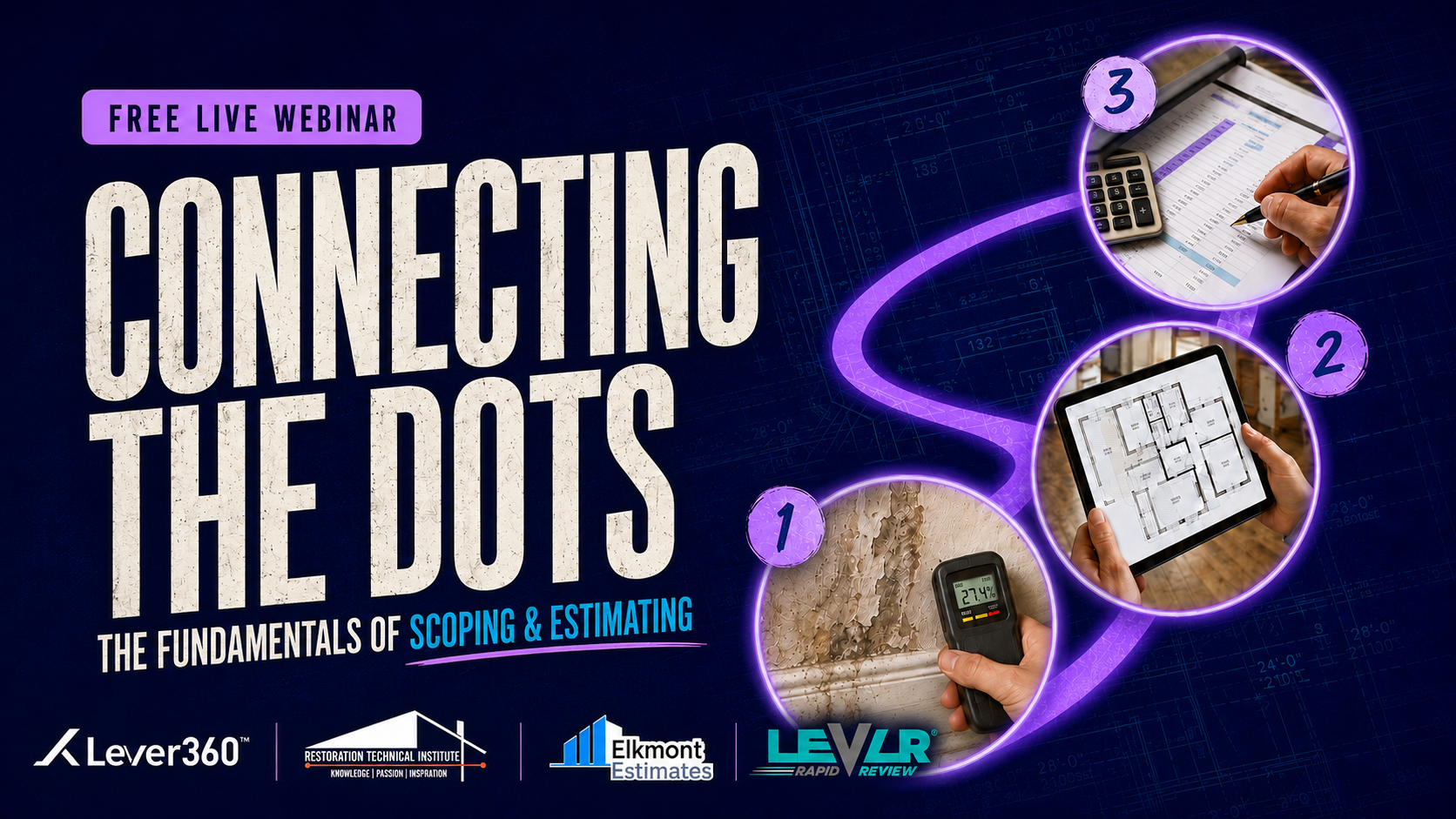
Connecting the Dots: The Fundamentals of Scoping & Estimating
Lever360 in partnership with Elkmont Estimates and Levlr
August 27, 2026
Together we'll discuss:
  • Why scoping influences profitability long before an estimate is written.
  • Common places restoration companies unintentionally leave revenue behind.
  • Why experienced estimators sometimes build different scopes, and how they support those decisions.
  • How technology is changing the scoping and estimating process.
  • A live water-loss case study that brings concepts together.
Whether you're a field technician, estimator, project manager, operations manager, or business owner, you'll leave with ideas you can apply for your next job.
Register for the free webinar
Because stronger estimates don't begin with better estimating. They begin with better scoping.

About the author

Lisa Lavender

CEO & Partner

The Lever360 Platform

Three levers. Pull all three and the whole company moves.

Lever360 is three products built around the same restoration job. Software runs the operation. Learning Lever trains the team. RTI certifies the trade. Use one. Use all three — they compound.

Software is one lever

You're running the company here. The other two make it compound.

Software runs the operation — every job, crew, dollar and conversation lives here. Add Learning Lever and RTI and the same techs ramp faster, bill higher, and stay longer. One lever moves the company. Three move it harder.

Learning Lever is one lever

You're training the team here. The other two make the training stick.

Learning Lever onboards faster and keeps the whole team sharp. Software is where that training shows up in the work. RTI is where it becomes a credential customers trust. Pull one — pull all three and the math compounds.

RTI is one lever

You're certifying the trade here. The other two carry the credential to the field.

RTI certifies the trade — IICRC WRT, ASD, AMRT, FSRT and beyond. Software runs the company those certified techs work for. Learning Lever ramps everyone in between. One lever moves things. Three move the whole crew.

Bundled Pricing

Customers who run Software + Learning Lever together save 22% and onboard techs 3× faster.

Keep reading

More from Field Notes

All articles →

Field Notes Weekly

One useful piece of restoration writing in your inbox every Week.

Operators, trainers, and IICRC instructors trade what’s working. 4

Thank you! Your submission has been received!
Oops! Something went wrong while submitting the form.

See the platform

Get Started with Lever360

With a real operator. We’ll show you the parts of Lever360 most relevant to the way you run today.