How to Train Someone From Outside or Inside the Restoration Industry
“How to Train Someone From Outside or Inside the Restoration Industry” explores a strategic approach to employee onboarding and workforce development in restoration companies. Rather than relying solely on certifications or isolated training events, the article introduces the Learning Paths Methodology — a structured, personalized training framework designed to reduce time to proficiency and improve long-term performance. The process begins with defining clear training objectives by task, function, or job title, followed by identifying required skills, inventorying the individual’s current capabilities, and determining the specific training needed to close performance gaps. From technical restoration skills and software proficiency to leadership development and communication abilities, successful training must address both hard and soft skills. By mapping timelines, assigning responsibility, integrating apprenticeship-style field training, and celebrating milestones, companies can create a deliberate and repeatable onboarding system. Investing in structured training programs, digital learning tools, and clearly defined expectations not only supports new hires but also strengthens company culture, retention, and operational consistency in a competitive labor market.
Lisa Lavender
CEO & Partner
March 4, 2022
8 Min.
Hiring outside the industry brings fresh ideas to your organization. It is a necessity for overcoming labor shortages and has many other advantages like avoiding the need to overcome bad habits that sometimes come with experience. You have a clean slate to train. So, now what?
Over the years, I have been asked the how and what of training a new person. I know everyone who has asked this question wants an easy answer like, “Send them to water restoration technician (WRT) training and then send them to ‘X’.” My answer typically involves me walking them through a simple series of questions.
Training a new person for success is not quite as simple as we may want. However, it can be simplified. When approached deliberately and applied consistently, setting up a new hire for success can be done and produce desired outcomes for both the company and employee. The first tip is that it should be a part of a developed on onboarding program. Are you on board with employee onboarding?
Next, I present the idea of a personalized learning path. In the context of the workplace, it is best defined as the “Learning Paths Methodology,” which, since 1993, has been applied as an employee training approach. It is touted as reducing time to proficiency by more than 30% in every case, across employees of diverse roles. As Learning Paths International explains, “A Learning Path is the series of learning activities that go from day one to proficiency. These activities include formal training, practice, experience and more.” The three principles of the employee training methodology include: 1) Learning as a process – not an event – extending beyond the classroom, 2) Knowing and doing are different things, 3) Training should be by design rather than by accident.
Learning paths provide a transparent and deliberate approach to the training process. At Restoration Technical Institute (RTI), the concept is a cornerstone to how we help companies with their training programs. Identifying gaps and needs helps individuals and companies achieve their goals. It is a basis for our development of curriculum so that needed resources are available and accessible. You can learn more about learning paths and other training technology at Learning Today with RTILearning.com.
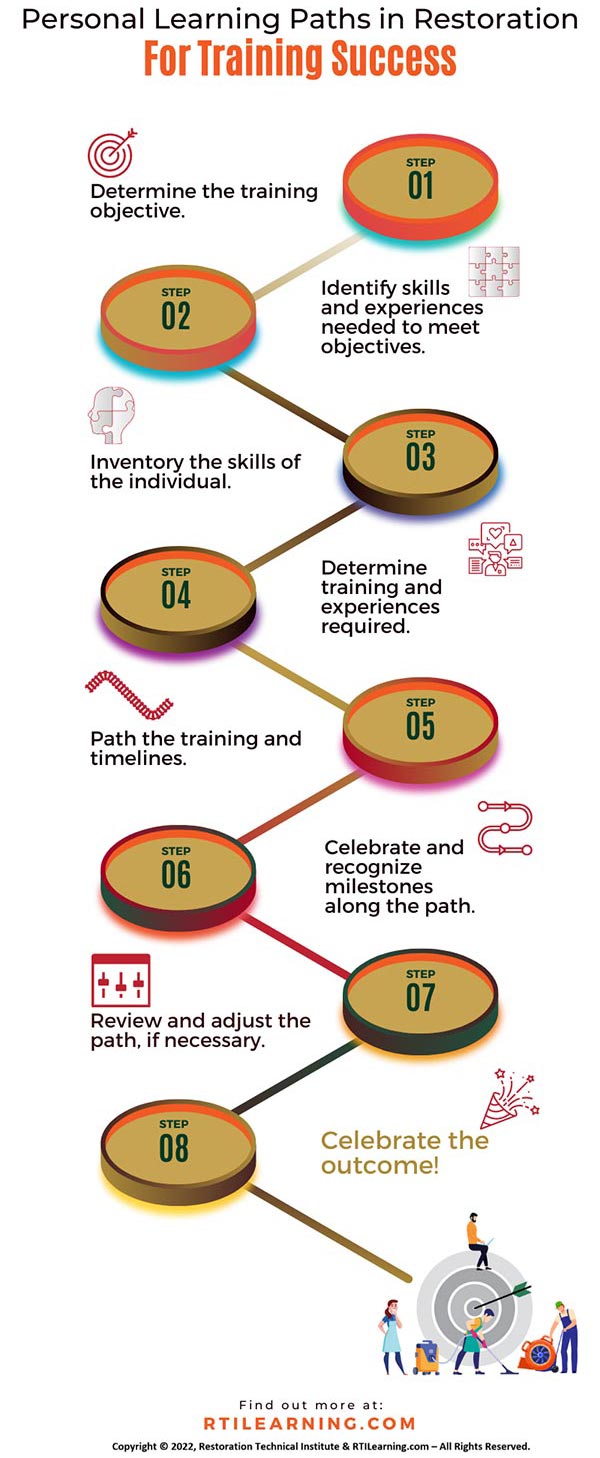
Steps to Develop Personal Learning Paths for Training Success
Determine the training objective. What is the desired outcome? You can approach this a few different ways. As you build the plan, keep in mind the complexity of the path will be based on the individual, their capabilities and limitations, as well as the desired outcome. Examples:
By task: Fire structure clean, extract water
By key function: Run a water loss, schedule coordination
By job title: Project manager, lead technician
Identify skills and experiences needed to meet objectives. It will be challenging to develop an effective training path if there is no clarity regarding the skills and experiences required for the objective. In “A New Tech Under Your Wing,” one of the tips calls for the use of a training guide or matrix. The matrix will allow you and your team to consistently apply a specific set of desired skills and proficiencies. It can also be a tool for the trainee to engage and have clarity on the requirements.Be sure to capture all the training necessary: Technical skills, soft skills, computer, software, equipment, products, safety and other specific company processes, etc. A brief example for a lead technician may have these elements:
Perform the following on water losses > 5,000 square feet
Calculate equipment and layout drying plan
Map and monitor
Remove baseboard, cove base, insulation, drywall
Set up equipment
Lead and supervise a crew of up to five people
Proficiency in using company software
Ability to communicate progress, changes and meaningful information to property owners
Completed on-the-job training by successfully engaging in:
Clearly defined experiences
Use of equipment/products/other
Account for company-specific training requirements that may include but are not limited to:
Standard operating procedures
Software and systems
Formal and informal processes
Inventory the skills of the individual. An inventory of the skills and capabilities the individual has may be determined by a combination of the following: Previous job experiences, credentials/certifications/degrees, assessment testing, skillful interviewing, etc.
Determine the training and experiences required. This can be viewed as a mathematical equation: Skills needed – skills present = training needed. An example of this may be an estimator from outside the industry who came to you with experience equivalent to the skills needed in sketching a building. Sketching may be a skill required for the position of the estimator, and this was accounted for in the individual’s inventory.
Path the training and timelines. Now that we know what the training needs are, we can lay them out, correlate timelines, and facilitate a path based on the individual and the criteria established.
Celebrate and recognize the milestones along the path. A learning culture and engaging the new person on their training journey is of great importance. It encourages everyone to celebrate and support each other’s learning and growth.
Review and adjust the path, if necessary. The idea is to make this personalized for the learner while meeting all company objectives. As an example, you may have pathed a water technician to learn to extract > set equipment > monitor > basic demo. As the learner progresses, you may notice that the monitoring and math may not be the best next training step after learning to set equipment. You then adjust and change the path to basic demo.
Celebrate the outcome! Following a basic system of training in your company will help you achieve consistency and positive results.
As you develop your systems to train people from outside or inside the industry, the learning path method will bring you success. The following is a short list of some of the things needed to help you effectively and efficiently deploy:
Budget: Training is an investment in our most valued asset, our people.
Assignment of responsibility: The company must support the responsibility of managing, deploying and pathing the team’s learning initiatives.
Apprenticeship and team: Have a defined expectation and the tools to measure the outcomes of field training. Other team members should be engaged in applying a consistent and positive approach to on-the-job training.
Resources and tools: Like everything else in this industry, there is a constant evolution of technology and resources. This makes the delivery and management of training easier than ever before. According to an article in Small Business Trends, 98% of planned to use eLearning by 2020.
May using Learning Paths bring you much restoring success.
Three levers. Pull all three and the whole company moves.
Lever360 is three products built around the same restoration job. Software runs the operation. Learning Lever trains the team. RTI certifies the trade. Use one. Use all three — they compound.
Software is one lever
You're running the company here. The other two make it compound.
Software runs the operation — every job, crew, dollar and conversation lives here. Add Learning Lever and RTI and the same techs ramp faster, bill higher, and stay longer. One lever moves the company. Three move it harder.
Learning Lever is one lever
You're training the team here. The other two make the training stick.
Learning Lever onboards faster and keeps the whole team sharp. Software is where that training shows up in the work. RTI is where it becomes a credential customers trust. Pull one — pull all three and the math compounds.
RTI is one lever
You're certifying the trade here. The other two carry the credential to the field.
RTI certifies the trade — IICRC WRT, ASD, AMRT, FSRT and beyond. Software runs the company those certified techs work for. Learning Lever ramps everyone in between. One lever moves things. Three move the whole crew.